

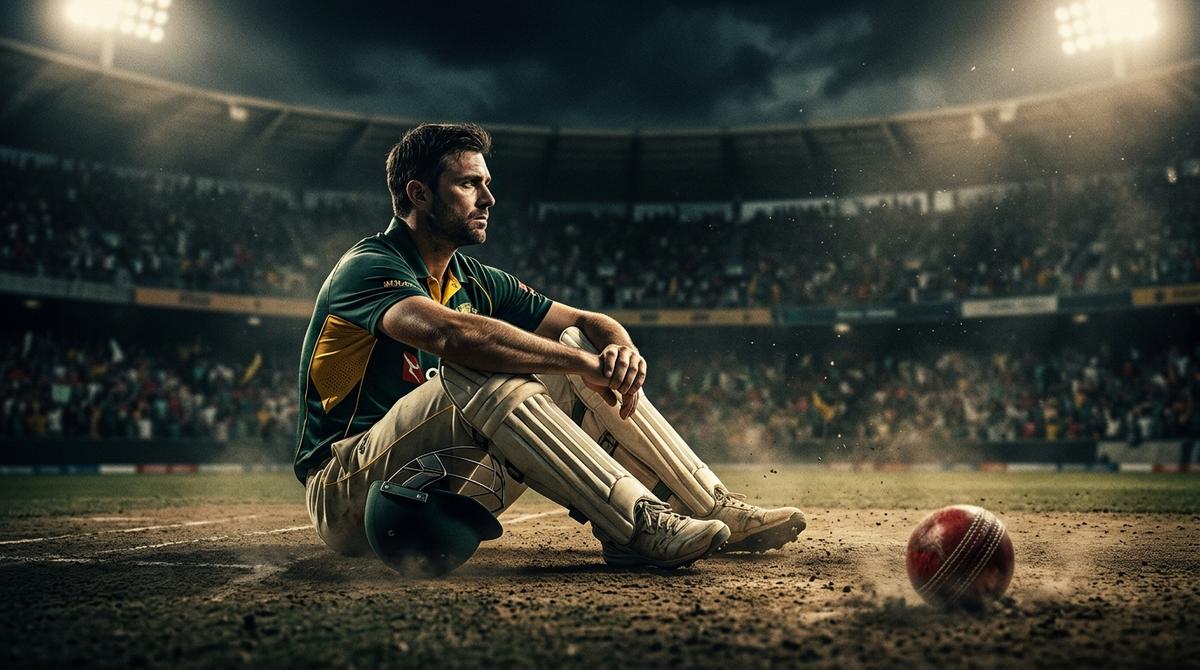
Usman Khawaja's book reopens old wounds, claiming CA never interviewed him about the Cape Town 2018 sandpaper scandal.
Alright, you lot! Gather 'round, grab your chai, because The Wrong Un has got a fresh pot of steaming controversy to spill. Just when you thought the dust from Cape Town 2018 had finally settled, buried under an avalanche of white-ball heroics and Ashes redemption, along comes Usman Khawaja to kick it all back up. And this, my friends, isn't just a gentle prod; it's a full-blooded scoop through mid-wicket, heading straight for the boundary of public perception. Because according to Uzzie, the ball-tampering scandal that rocked Australian cricket to its very foundations wasn't quite as thoroughly investigated as we were led to believe.
In what promises to be an explosive autobiography, Khawaja is set to unveil his version of events from that infamous Cape Town Test. And the headline? A claim that sends shivers down the spine of anyone who thought they knew the full story: he was never interviewed by Cricket Australia (CA) about the incident. Never! Arre bhai, if true, that’s not just a crack in the façade, that’s a gaping chasm where the bedrock of accountability should be.
Think about it. The entire cricketing world watched in horror as Australia’s reputation, once synonymous with fierce but fair competition, crumbled quicker than a stale biscuit. David Warner, Steve Smith, and Cameron Bancroft were slapped with unprecedented bans. CA launched what they touted as a comprehensive investigation, promising transparency and a clean slate. Yet, a senior player, a genuine voice in the dressing room at the time, now alleges he wasn't even called in for a chat? It's like finding out the chef didn't taste the dish before serving it at a five-star hotel. Unbelievable, frankly.
The Pitch Report: The Aftermath's Gritty Surface & CA's Contested Narrative
Let's talk about the 'pitch' on which Cricket Australia conducted its post-Sandpapergate clean-up operation. It wasn't a pristine, green top, nor was it a flat road offering easy runs. It was a dusty, worn-out surface, riddled with pressure cracks from public outrage, media scrutiny, and corporate backlash. CA's primary objective wasn't necessarily to uncover every single detail – it was to cauterise a bleeding wound and present an image of decisive action and moral regeneration.
The conditions were hostile. Reputations were on the line, careers hanging by a thread. In such an environment, an organisation often prioritises damage control over exhaustive truth-seeking. Khawaja's revelation suggests that CA's investigation might have been less about a forensic examination of *who knew what and when* and more about identifying the immediate culprits and drawing a swift, unambiguous line under the debacle. The narrative was simple: a few individuals made a grave error, and the organisation is now cleaning house. If Khawaja's claims hold water, it implies CA might have deliberately, or conveniently, avoided deeper dives that could have implicated a wider circle or revealed systemic issues.
“To simply say that Cricket Australia’s investigation was thorough and complete, when a player actively present in the dressing room at the time claims he was never spoken to, raises significant questions about its integrity. It points to a prioritisation of narrative control over genuine accountability.”
This isn't just old news rehashing; this is a direct challenge to the legitimacy of the process that led to those severe bans and the subsequent 'cultural review'. It hints at a possible selective investigation, perhaps designed to ring-fence the scandal rather than truly expose its full extent. The 'sandpaper details' weren't just about a foreign object; they were about a deeper malaise, and Khawaja's book threatens to re-open that wound.
The Wagon Wheel: Khawaja's Batting Arc and the Shadow of Sandpapergate
Usman Khawaja has always been a fascinating character in Australian cricket. An elegant left-hander, often perceived as an outsider in a system that traditionally championed a more rugged, aggressive archetype. His career wagon wheel has been a story of resilience, comebacks, and consistently proving doubters wrong. From being dropped multiple times to becoming a bedrock of the Test team, especially in recent years, his journey is a testament to perseverance. He’s scored runs all over the park, often when others struggled, defying expectations.
But the shadow of Cape Town has loomed large over that era of Australian cricket. Khawaja, despite not being directly implicated, was part of that dressing room. His silence, perhaps perceived by some as complicity or fear, now takes on a new context. This autobiography isn't just about recounting his personal journey; it's about Khawaja reclaiming his narrative, drawing his own lines on the wagon wheel of history.
Did Cricket Australia's Investigation Truly Clear the Air on Cape Town 2018?
This is the million-dollar question now. If a player like Khawaja, present in the team, claims he was never interviewed, it undermines the very foundation of CA's 'clean-up' operation. It throws a cloud of suspicion over:
- The scope of the investigation: Was it genuinely exhaustive, or did it deliberately limit its reach to avoid inconvenient truths?
- The integrity of the findings: Can we truly trust that all relevant information was gathered and assessed?
- Player welfare and trust: If players felt unheard or bypassed, what does that say about the relationship between the board and its most valuable assets?
The impact of this book could be far-reaching. It could force a re-evaluation of the entire incident, potentially sparking fresh debate, and even, dare I say it, demands for a new, truly independent inquiry. It’s paisa vasool for Khawaja, not just in book sales, but in solidifying his place as a man who finally spoke his truth, years after the fact. It highlights the often-strained dynamics between players and their governing bodies, particularly when controversies erupt.
The Lingering Questions & Future Ripples
This isn't just about Usman Khawaja telling his side of the story; it's about the broader implications for governance in cricket. How do boards handle crisis? Do they truly prioritise truth, or reputation management? The Sandpapergate scandal was a watershed moment, leading to significant cultural shifts within Australian cricket. But if foundational elements of the investigation are now questioned, what does it say about those reforms?
This autobiography will surely ignite a fresh round of discussions, forcing former players, administrators, and fans to re-examine what they thought they knew. It reminds us that history is often written by the victors, or in this case, by the official narrative. But sometimes, a lone voice, years later, can peel back the layers and expose the uncomfortable truths buried beneath the surface. And for that, The Wrong Un says: bring on the book, Uzzie. Let’s hear the full story, warts and all.