

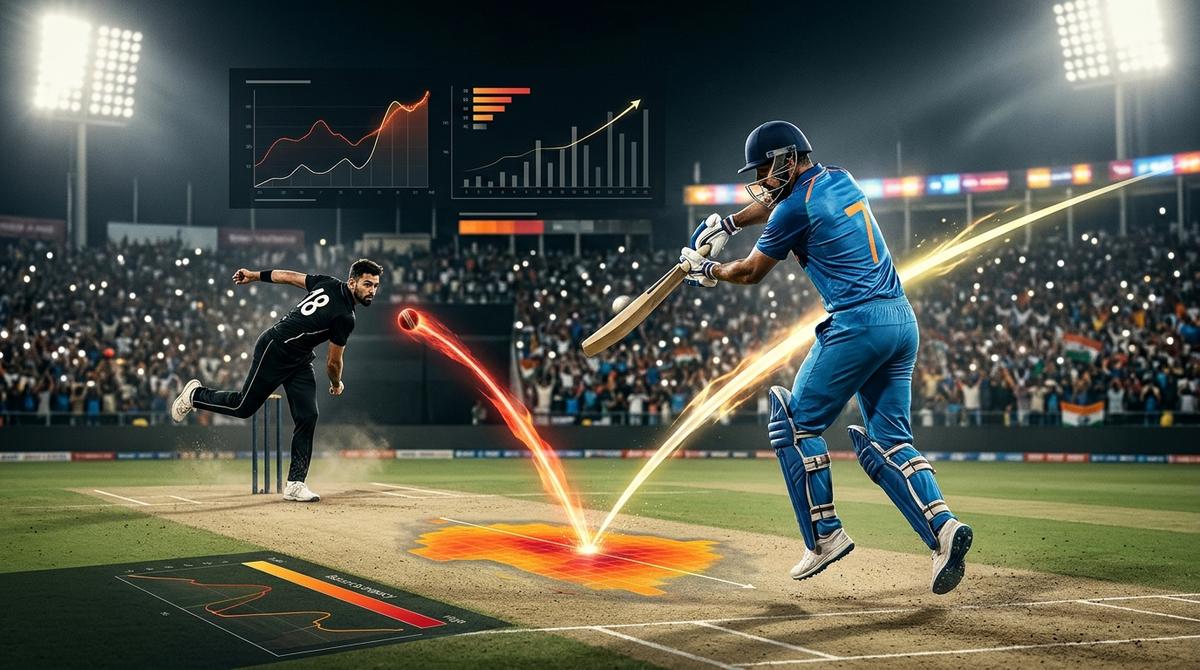
Eden Park's bounce: A tactical conundrum for India and New Zealand's World Cup ODI blueprint.
Alright, CricPaglu patrons, Priya DataDevi reporting for duty. My algorithms have been churning, my statistical models are pulsating, and the data points are screaming one consistent message: Eden Park. Specifically, the 'bouncy' Eden Park. We've got India and New Zealand gearing up for a series of One Day Internationals, and make no mistake, this isn't just another bilateral fixture. This is high-stakes World Cup reconnaissance, a tactical dress rehearsal where every variable is scrutinized, from mean run rates to boundary probability distributions.
Just four days ago, the same Eden Park witnessed a T20I spectacle – a high-scoring affair that had the statisticians amongst us furiously recalibrating their expected value models. But here’s the critical intel: the conditions for these upcoming ODIs are anticipated to be significantly different. And that, my friends, is where the analytical fun truly begins. It’s not about rewriting history; it's about predicting the future with a higher degree of certainty, based on observed patterns and environmental shifts. Or as we say in the data world, mitigating the noise from the signal. Chalo, let's dive in.
The Pitch Report: Unpacking Eden Park's 'Bounce' Coefficient
When the intelligence brief labels Eden Park as 'bouncy', it immediately triggers a cascade of tactical implications. 'Bouncy' doesn't just mean the ball comes on; it implies variable carry, potential seam movement, and a discernible difference in trajectory for pace bowlers. For a T20I, a flat-out bouncy track can be a batsman's paradise – easy pace to work with, pull shots flying into the stands, and the ball racing to the boundary like a well-optimized query. The previous T20I's high scores are a testament to this.
However, ODIs are a different beast. We’re talking 300 deliveries per side, not 120. This extended duration alters the optimal bowling lengths and batting strategies significantly.
- For the Bowlers: A bouncy pitch in ODIs allows fast bowlers to assert dominance beyond just sheer pace. They can target the ribs, exploit the top edge with well-directed bouncers, and challenge batsmen with deliveries that rear up unexpectedly. The full delivery, previously a boundary ball in T20s, becomes a potent weapon for swing and late movement. We might see more effective use of the cross-seam delivery, generating that unpredictable lift. The key will be maintaining disciplined lines, adjusting the length by approximately 0.7 to 1.2 meters fuller than a typical T20 length to exploit early seam.
- For the Batsmen: The initial Powerplay on a bouncy track demands extreme caution. Unlike T20s where every ball is an opportunity, ODI batsmen must ride out the early storm, focusing on rotating the strike and preserving wickets. The probability of an edge carrying to the slips is higher. As the innings progresses, batsmen who are adept at playing off the back foot – think controlled pulls, cuts, and punches – will find their rhythm. Those who rely purely on front-foot driving might struggle against the extra lift. Expect to see lower boundary counts in the initial 10-15 overs compared to the preceding T20I.
- Spinners' Role: On a truly bouncy track, finger spinners might find less grip and turn, but wrist-spinners who can generate overspin and dip could still be effective. The extra bounce could translate into over-the-shoulder catches or mis-hits for leg-spinners and googlies that 'kick'. The mid-overs squeeze, often dominated by spin in ODIs, will now likely require a more balanced pace-spin attack.
The tactical chess match here is about exploiting the ‘bouncy’ nature without becoming predictable. A good captain will understand that the optimal bowling matrix for a T20 is a subset, not a superset, of an ODI strategy on the same surface. It's about adapting the variable distribution of risk and reward across 50 overs.
The Wagon Wheel: Plotting World Cup Trajectories
In the grand calculus of international cricket, bilateral ODIs leading into a World Cup are more than just points on a ledger; they are crucial data points for refinement. This India-New Zealand series at Eden Park is essentially a live-fire exercise for both nations, charting their wagon wheels towards global dominance.
- World Cup Prototyping: Both teams will be testing combinations, trying out specific roles, and pushing the boundaries of their tactical playbooks. For India, this might involve solidifying middle-order dynamics or evaluating death bowling options. New Zealand, ever the pragmatists, will be looking to fine-tune their all-rounder balance and perhaps give fringe players a high-pressure audition. Remember the 2019 World Cup semi-final? The ghosts of Old Trafford still linger for India, adding an extra layer of competitive intensity to any encounter with the Black Caps.
- Player Trajectories: For individual players, these ODIs are career inflection points. A strong performance here, especially under varying conditions, can cement a spot in the World Cup squad or even elevate a player's standing within the team hierarchy. Conversely, a dip in form could lead to agonizing conversations with selectors. We often see players experimenting with new techniques – a bowler trying a different slower ball variant, a batsman adjusting their trigger movement – using these matches to validate changes under match conditions. It's about optimizing their individual performance curves for peak output.
- Historical Context & Rivalry: India vs. New Zealand in ODIs is a rivalry marked by unexpected twists and tactical brilliance. While not the Ashes or a Border-Gavaskar Trophy, these contests often deliver paisa vasool cricket. New Zealand's uncanny ability to punch above their weight, especially in ICC tournaments, means India can never take them lightly. Historically, New Zealand's disciplined bowling and aggressive fielding have often been their differentiators against the subcontinental giants. These ODIs will serve as fresh data points in this evolving narrative, influencing future tactical plans and psychological battlegrounds.
- Format-Specific Trends: Modern ODI cricket has seen an increased emphasis on accelerating in the middle overs and brutalizing the death overs. However, a bouncy Eden Park might force a slight regression to a more traditional ODI template – building innings, picking gaps, and then exploding in the final 10-12 overs. It’s about understanding the variable coefficient of risk-taking at different stages of the innings based on environmental factors. The team that adapts this understanding most efficiently will likely emerge victorious.
In essence, this series is a critical data acquisition phase. Every dot ball, every boundary, every strategic decision will be logged, analyzed, and integrated into the overarching World Cup strategy. It's less about winning every single match, and more about perfecting the meta-game, understanding the probabilities, and minimizing variance when it truly matters. Arre bhai, this is not gully cricket; this is data-driven warfare.