

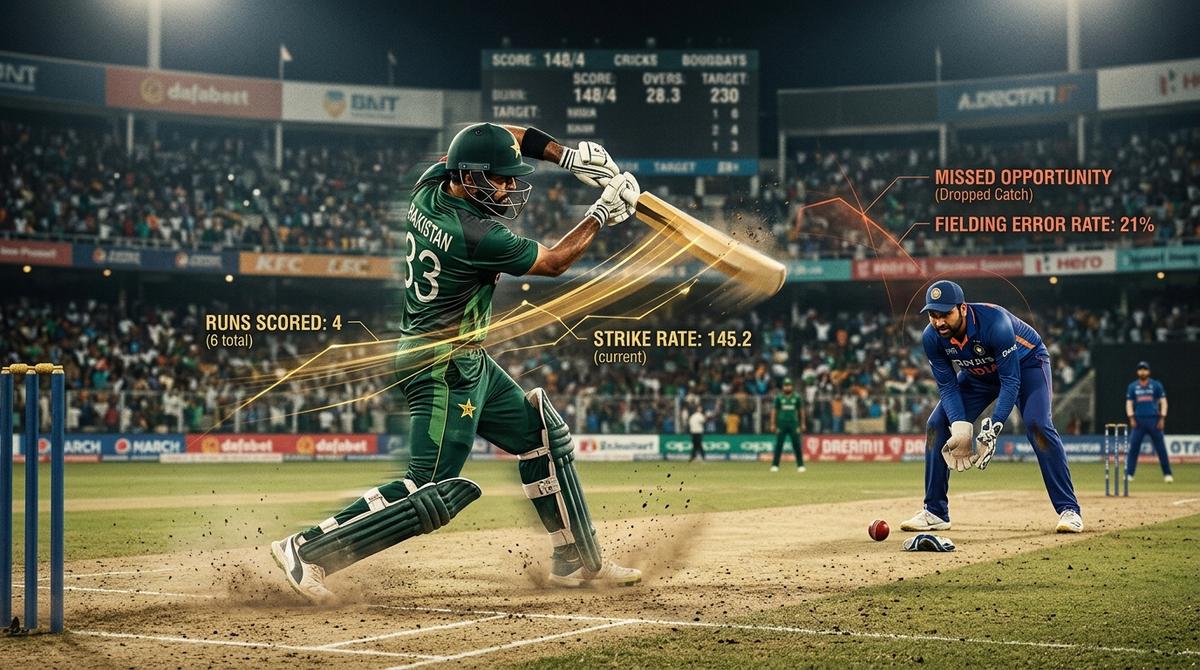
Pakistan's resilience (Nawaz & Minhas) vs. England's fielding woes (Sonny Baker's wickets). The data doesn't lie: every missed chance matters!
Greetings, data-devotees and statisticians of the sticky wicket! Priya DataDevi here, peering through the binary mist on behalf of CricPaglu, armed with more algorithms than a DRS review gone rogue. Today, we're dissecting a fascinating ODI encounter where the numbers tell a story of resilience, opportunity, and, dare I say, a few dropped decimal points in the fielding department.
The headline act, as our raw intelligence data screams, is that Pakistan Scored 302 After Recovering From 81 For 4 vs England, With Sonny Baker Taking Three Wickets. Now, let's unpack that. An 81 for 4 start is, statistically speaking, suboptimal. It's the equivalent of forgetting your laptop charger on a match day – a panic-inducing deficit. Yet, Pakistan, like a well-optimized algorithm, found their 'if-then' statements, with Nawaz and Minhas emerging as the variables that ultimately yielded a total of 302 runs. Both gentlemen registered crucial fifties, pulling their side from the brink of a sub-200 total, which, if we consult historical run-rate distributions for the format, would have put them well below the mean for competitive ODI scores post-2015.
On the other side of the ledger, England's bowling unit saw Sonny Baker claim three wickets. A commendable performance, certainly. However, the qualitative data point, "England's fielding was described as 'sloppy'," reverberates louder than a mis-hit into the stands. In an era where Expected Wickets (xW) and Fielding Impact metrics are as critical as actual wickets taken, 'sloppy' is a four-letter word that can cost you more than just runs; it costs momentum, confidence, and ultimately, matches. This isn't just about the physical act; it's about the psychological compounding interest of missed opportunities. Let's delve deeper, shall we?
The Pitch Report: Unseen Variables and Unforgiving Data Gaps
Ah, "The Pitch Report." The sacred scroll, the pre-match divination for any self-respecting cricket analyst. Regrettably, our specific intelligence data for this encounter lacks an explicit pitch classification. A significant data gap, I must say, and one that sends shivers down the spine of any true empiricist. Without the 'Green,' 'Dusty,' 'Flat,' or 'Turning' labels, we're left to infer, which, while not ideal, is where a seasoned analyst – and a bit of historical pattern recognition – comes into play.
Consider Pakistan's trajectory: 81 for 4, then a recovery to 302. This pattern strongly suggests one of two scenarios, or a hybrid thereof:
- Early Movement/Initial Challenge: The first few overs, perhaps during the Powerplay, likely offered something for the bowlers. Maybe a touch of lateral movement, or perhaps just a fresh surface allowing for zip and bounce. An early four-wicket cluster at such a low score is rarely due to flat-track batting artistry. It points to either genuine bowling prowess (which Sonny Baker's three wickets support) or batsmen still calibrating their risk assessment against a challenging length.
- Flattening Out or Adaptive Batting: For Nawaz and Minhas to then build significant fifties, the pitch either settled down considerably – becoming 'flatter' and more conducive to stroke play in the middle overs – or their tactical approach was exemplary. On a pitch that starts with movement, adapting to a straighter, fuller length is key, often accompanied by running the ball into gaps rather than forcing boundaries. The 'death overs' phase, even on a flat track, demands precision from bowlers and calculated risks from batsmen. Did England's bowlers fail to adjust their lengths, sticking to a pre-programmed plan when the surface demanded a different execution matrix?
England's 'sloppy fielding,' regardless of pitch type, amplifies the impact of any batting recovery. A dropped catch isn't just a missed wicket; it's an extended stay at the crease, potentially allowing a set batsman to reach a fifty, or even a century. If the pitch had become a batsman's paradise, those fielding lapses become exponential multipliers for the opposition's total. Imagine a Yorker that would have been a dot ball becoming a boundary because of a misfield, or a potential run-out opportunity squandered, costing crucial momentum shifts.
In the grand scheme of ODI cricket, where batting units aim for a statistical efficiency above 6.0 runs per over in the middle phase, and escalate towards 8.0-10.0 in the final ten, a recovery like Pakistan's hints at a surface that eventually offered value for good batting. Conversely, it hints at a bowling attack that, despite early success, couldn't maintain its stranglehold, potentially exacerbated by an inability to back up the good balls in the field. This isn't about blaming individuals; it's about the systemic failure to close out innings, a common tactical challenge even for top teams like England in ODI format, especially when facing a determined lower-middle order. The data, even in its absence of explicit pitch info, speaks volumes about the unfolding drama.
The Wagon Wheel: Trajectories, Trends, and the Unseen Hand of History
The 'Wagon Wheel' section is where we connect the dots, transcend the immediate scorecard, and project these singular data points onto the larger canvas of cricketing careers and format-specific trends. For Nawaz, Minhas, and Sonny Baker, this match provides critical data for their respective trajectories.
- Nawaz & Minhas: Architects of Resilience: For Pakistan, a recovery from 81/4 to 302 isn't just a numerical feat; it's a statement. It signals maturity, partnership building, and crisis management under pressure. In ODI cricket, where middle-order collapses are often terminal, these fifties are gold. Are these a statistical anomaly or a sign of increasing consistency? Further analysis of their 'Ball-Dismissal Probability' against different bowling types and phases would be crucial. Historically, Pakistan has had a penchant for both spectacular collapses and equally spectacular recoveries – think back to their World Cup runs where moments of individual brilliance salvaged seemingly lost causes. For these players, such performances could solidify their place, especially in a lineup constantly seeking reliable accumulators who can navigate the post-Powerplay phase and accelerate towards the death overs. In the context of upcoming series, this data point will heavily influence team selection and tactical plans, marking them as vital anchors.
- Sonny Baker: The Emerging Threat: Three wickets are a significant return for any bowler, particularly against an international side. For a younger player like Sonny Baker, this isn't just a good day; it's a data point that gets flagged with neon lights in the analyst's dashboard. Is he a Powerplay specialist with a potent inswinger? Or does he possess the slower balls and Yorkers required to be effective in the death overs, a skill set honed by modern T20 leagues like the IPL and Big Bash? His 'Wickets Per Match (WPM)' and 'Economy Rate (ER)' will be closely monitored. This performance could be the catalyst for more opportunities, potentially pushing him up the national selection pecking order. Every great bowler, from Shane Warne to Wasim Akram, had these 'breakout' performances that became foundational data points in their legendary careers.
- England's Fielding: A Glitch in the Matrix? The description 'sloppy fielding' is a stark contrast to the modern England white-ball setup, often lauded for its athleticism and high-performance standards. Is this a one-off blip in the 'Fielding Efficiency Rating (FER)' or a systemic issue emerging? Data analysts track 'Dropped Catch Percentage (DCP)', 'Misfield Rate (MR)', and 'Run-out Opportunities Missed (ROM)' with forensic detail. Such lapses can shift 'Expected Wins (xW)' outcomes by significant margins. In the context of high-stakes tournaments like the Ashes or even major ICC events, where every run and every ball counts, these seemingly minor errors accumulate. It speaks to a need for recalibration, perhaps revisiting foundational drills or analyzing fatigue data. The business of cricket demands perfection; any deviation impacts brand, performance, and commercial viability. This match serves as a crucial data input for England's high-performance review processes.
This result, therefore, isn't just about 302 runs or three wickets. It's a rich tapestry of individual performances influencing career graphs, tactical adaptations under pressure, and the relentless pursuit of statistical perfection. It’s why we, the data paglus, exist – to find the story beyond the score.
So, what have we learned from this particular dataset? Pakistan's middle order demonstrated a commendable capacity for recovery, turning a precarious situation into a competitive total. Nawaz and Minhas stepped up with fifties, proving that calculated aggression and smart cricket can overcome early setbacks. England, while seeing a promising performance from Sonny Baker, will undoubtedly be reviewing their fielding metrics with a fine-tooth comb. In the high-stakes world of international ODI cricket, every run saved, every catch held, is a data point that contributes to the win probability. Until next time, keep crunching those numbers, and remember: the ball tells a story, but the data tells the truth!