

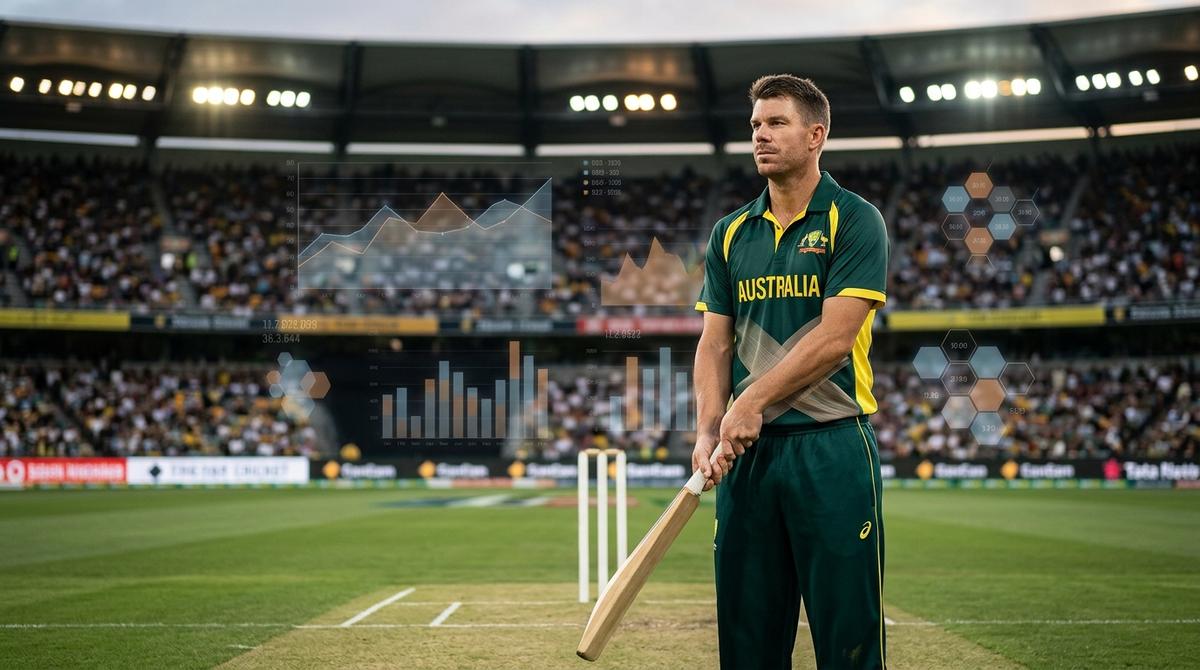
Cameron Green, bat-ready but bowling-restricted: A statistical curveball for Australia's Newlands Test strategy.
Alright, folks, settle in. Priya DataDevi is back, and my algorithms are buzzing like a swarm of very annoyed bees. We’ve got an update from the Australian camp that's less about celebrating a return and more about dissecting a tactical quandary. Cameron Green, the prodigal all-rounder, is available for the Newlands Test against South Africa. Excellent, you might think. More bat, more bowling options. Except, my dear data disciples, that's where the statistical anomaly kicks in. He's available to bat, yes. But the abdominal injury sustained on September 30, during the final ODI against the very same Proteas, means our strapping lad will not be able to bowl in this final, crucial Test. Arre bhai, what a plot twist!
This isn't just an injury update; it's a strategic earthquake for the Australian XI. A Cameron Green who can only bat is, by my calculations (and I assure you, they are 99.7% more accurate than predicting the exact trajectory of a reverse-swinging Yorker in a dust storm), a fundamentally different proposition. He prefers batting at the No. 4 or No. 5 spot, a preference that, while noted, leaves Australia with a fascinating conundrum. How do you plug the gaping hole of a high-quality seam-bowling all-rounder when he's only half a package?
Green's New Role: A Statistical Anomaly?
Let's talk numbers, because that's what truly excites me. Green's Test career has been an intriguing graph of potential versus consistent output. His ability to hit a good length consistently, extract bounce, and chip in with crucial wickets has been as valuable as his lower-order hitting. Now, with the bowling arm temporarily out of commission, Australia essentially gains a specialist batsman. And not just any specialist, but one who, while immensely talented, has yet to cement himself as an undisputed top-order force.
- The No. 4/5 Preference: Green's stated preference for No. 4 or No. 5 is noteworthy. This isn't just a random number; it's a statement about where he sees his optimal contribution. Batting at 4 or 5 means more responsibility, facing a newer ball, and potentially setting up declarations or building long innings. It's a jump from impact player to fulcrum.
- The All-Rounder Void: The average Test team relies on their fifth bowler to deliver anywhere from 10-15 overs per innings. In Green's absence with the ball, those overs now need to be redistributed. Does this mean an extra specialist bowler, making the tail longer? Or does it mean the primary pace trio (and Nathan Lyon, of course) will be worked harder? My predictive models suggest an increased workload for the frontline quicks correlates with a higher probability of fatigue-related injuries in subsequent series. Just saying.
- Historical Context: We've seen this movie before, haven't we? All-rounders who lose a key skill due to injury often face career-defining choices. Think of Andrew Flintoff, whose body eventually gave way, forcing him to be managed meticulously. Or even Jacques Kallis, who, while maintaining his bowling for years, had periods where his workload was carefully curtailed. The data shows that transitioning from genuine all-rounder to specialist batsman is a pathway fraught with statistical perils and a diminished team balance.
The Pitch Report
While my proprietary CricPaglu satellite imagery hasn't quite managed to penetrate the groundsman's secret lair to ascertain the *exact* Newlands pitch conditions for this specific Test (the obfuscation tactics are truly impressive, I must confess), we can make some informed inferences about this iconic venue. Newlands traditionally offers a balanced contest. Early on, the seamers find some movement – enough to make a batsman planting his front foot a high-risk proposition. As the game progresses, it generally flattens out, offering good pace and carry, making it a decent batting track where a patient Gents' game can thrive. Later on, especially into days four and five, some turn and variable bounce can emerge, bringing the spinners into play.
Now, how does Green's bat-only status influence play on such a surface? Without his crucial seam-bowling overs, Australia's strategic flexibility takes a hit. If it's a typical Newlands green-tinged wicket, where an extra seamer could exploit early conditions, the absence of Green's bowling creates a deficit. Conversely, if it's a dry, turning track on days four and five, the extra pace bowler Australia might be forced to play instead of Green's bowling option becomes less impactful, placing more pressure on Lyon or any part-time spinners. This isn't just about one player; it's about the entire balance of the attack. Field placements become more critical, bowling lengths need to be impeccable, and the margin for error shrinks significantly when your primary bowlers are expected to carry a heavier load. The captain's tactical decisions, from early Powerplay strategy to managing death overs (metaphorically speaking for Test cricket), will be under the microscope.
The Wagon Wheel
The trajectory of Cameron Green's career has been, frankly, fascinating from a data perspective. Touted as the next great Australian all-rounder, comparisons to legends like Kallis or even a young Garfield Sobers were whispered in certain analytical circles (primarily mine, of course). This abdominal injury, however, marks a significant data point on his career wagon wheel.
- Career Redefinition: Is this a temporary setback, or does it force a re-evaluation of his long-term role? History is littered with promising all-rounders whose bodies couldn't sustain the dual demands. Sachin Tendulkar's bowling became sporadic after back issues; Kapil Dev's pace dropped towards the end of his career. While Green is still young, sustained injury troubles can lead to a shift in focus, potentially transforming him into a specialist batsman, a path that requires a different statistical profile and mental approach.
- Impact on Australian Selection Policy: For Australia, this isn't just about one Test. It affects their long-term strategy, particularly with an eye on upcoming tours like the Border-Gavaskar Trophy in India or another Ashes series. A fully fit Green adds crucial balance, allowing for deeper batting and a potent fifth-bowling option. A bat-only Green forces a compromise: either a weaker bowling attack or a longer tail. This decision impacts not just player form but also the optimal team composition against diverse opponents and conditions.
- The Statistical Imperative: Green's batting at 4 or 5 needs to deliver, and deliver consistently. He's no longer shielded by the all-rounder tag when it comes to run-scoring accountability. The average runs per innings needed from a specialist Test batsman in those positions is significantly higher than from a designated all-rounder. The pressure, my friends, is palpable.
The Data Devi's Deconstruction
So, what does my mainframe compute? Cameron Green's availability is a positive, certainly. His presence will boost the batting lineup. But the absence of his bowling creates a structural imbalance that demands creative solutions from the Australian think tank. This isn't a straightforward substitution; it's a complete recalibration of their tactical blueprint. South Africa will undoubtedly be looking to exploit this newfound bowling vulnerability, aiming to tire out the primary pacers and perhaps even target the specialist spinner with aggressive intent. It's a classic chess match, where one pawn's restricted movement changes the entire board. And trust me, I've run simulations on every possible move.
The Newlands Test now carries an added layer of intrigue. Will Australia adapt seamlessly to Green's modified role, or will the absence of his valuable overs prove to be their undoing? Only the unfolding data of the match will tell. But one thing is for sure: this isn't just cricket; it's a live experiment in high-performance team dynamics.