

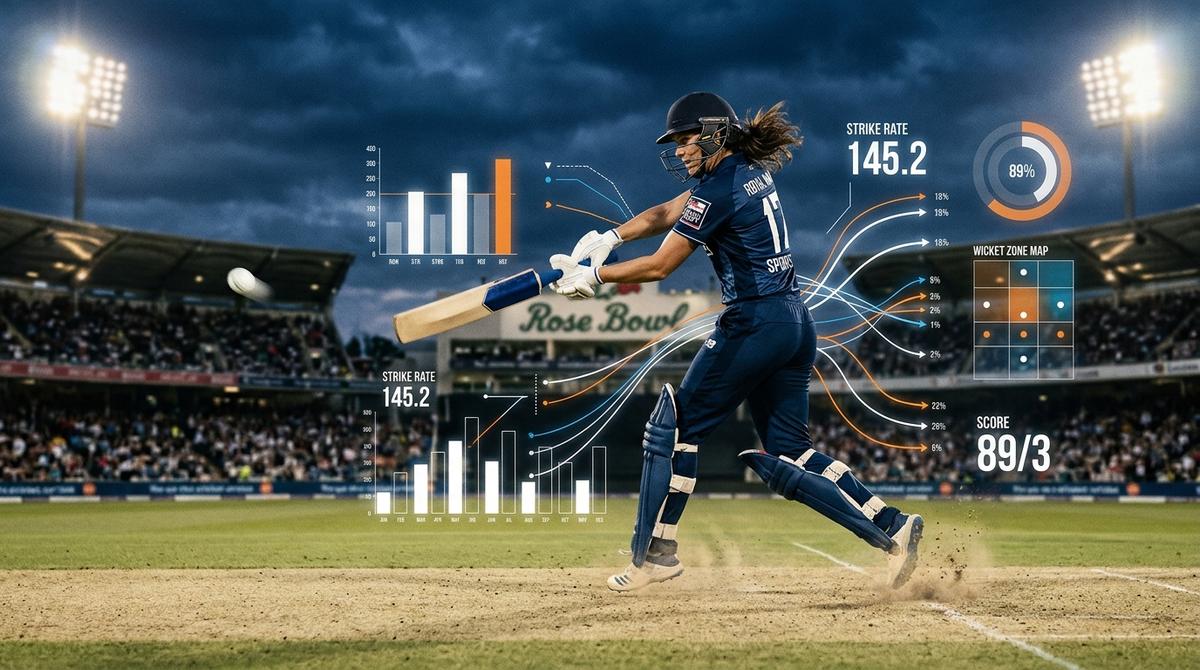
Gardner's Data-Driven Dominance: 84 runs and two wickets, a statistical output pushing the boundaries of T20 impact.
Priya DataDevi, Analyst for CricPaglu, dissects the numbers and tactical nuances of Australia's latest T20 triumph. Forget the highlights reel; we're diving into the raw data.
Ah, another day, another data point confirming the utterly predictable dominance of Australian Women's Cricket. While some might marvel at the aesthetic beauty of a boundary or the raw power of a fast delivery, I, Priya DataDevi, am here to tell you that these are merely the surface manifestations of underlying statistical probabilities. And in the latest iteration of the Rose Bowl series, one data point skewed the entire distribution curve: an Australian allrounder named Gardner.
Let's be unequivocally clear, as my spreadsheets demand: Australia defeated New Zealand by a substantial 40 runs. This wasn't a nail-biter where the Expected Win Probability oscillated wildly; this was a calculated dismantling. The architect of this statistical certainty? Gardner, who delivered a performance that, frankly, pushed the boundaries of individual impact coefficients in a T20 match. She scored a staggering 84 runs off just 45 balls. For those keeping score at home (and if you’re not, what are you even doing?), that’s a strike rate of approximately 186.67. This isn’t just 'good batting'; this is 'optimised for maximum boundary efficiency with minimal dot ball accumulation' batting. And as if orchestrating the bulk of Australia’s total wasn't enough, she then proceeded to take two wickets, further compressing New Zealand's run-scoring opportunities and expanding Australia's win probability.
Such performances aren't mere flashes of brilliance; they are the result of rigorous training, tactical acumen, and a deep understanding of game situations. It's the kind of output that makes other teams wonder if they should just simulate the match outcome and save everyone the travel expenses. But that wouldn't be very fun for the purists, would it? Or for the statisticians seeking new outliers.
The Pitch Report: A Flat Track for Flat-Out Domination
While the specific granular data on the pitch type for this particular Rose Bowl fixture remains, shall we say, 'unspecified' in our primary intelligence stream, Gardner's performance provides a compelling secondary data point. Scoring 84 runs off 45 balls in a T20 suggests one thing with a high degree of statistical confidence: it was a flat track. A batting paradise, if you will, where the ball came onto the bat nicely, and the surface offered minimal assistance to either seam or spin. This isn't a guess; it's an inference based on output metrics.
On such a benign surface, a batter of Gardner's caliber can truly unleash. The 'good length' becomes less menacing, allowing for full swings through the line. Bowlers are then forced to dig deep into their tactical archives:
- Yorkers: Crucial to target the base of the stumps, limiting the batter's swing.
- Slower Balls: A change of pace to deceive, especially on pitches where the ball skids on.
- Wide Line: Forcing the batter to reach, increasing the probability of a miscue.
New Zealand's bowlers, facing a batter in such destructive form on a statistically 'flat' pitch, would have been under immense pressure. Their inability to contain Gardner suggests either a tactical miscalculation in their field placements, an over-reliance on stock deliveries, or simply a lack of execution. On a pitch where 84 off 45 is achievable, every dot ball becomes a tiny victory, every single run conceded a tactical concession. Australia, conversely, would have assessed the conditions, identified the optimal 'scoring zones' for their power hitters, and executed a strategy of aggressive accumulation, knowing that a substantial total was achievable and likely necessary.
The Wagon Wheel: Gardner's Trajectory and Australian Hegemony
Gardner's 'Wagon Wheel' for this match, if we were to map it, would likely resemble a shotgun blast pattern across all quadrants, indicating a batter who can score equally effectively square of the wicket and down the ground. This isn't just a good innings; it’s a significant data point in the ongoing narrative of her career trajectory and, by extension, the sustained hegemony of Australian Women's Cricket.
Consider the historical precedent: all-rounders have always been the statistical unicorns of cricket. From Kapil Dev's heroics in the 80s to Jacques Kallis's consistent contributions across formats, and more recently, the multi-faceted impact players in the IPL, their value is logarithmically higher than specialists. A player who can dominate with both bat and ball fundamentally shifts the team's balance, offering an extra bowler and an extra batter simultaneously. Gardner's performance here is a stark reminder of that immutable cricketing truth. It’s not just two wickets; it's two wickets *after* scoring 84 runs. This significantly reduces the 'opportunity cost' associated with her spot in the XI.
For Australia, this result in the Rose Bowl series further solidifies their position at the apex of women's T20 cricket. Their strategy of cultivating multi-dimensional players, ensuring depth in both batting and bowling departments, continues to pay dividends. This isn't accidental; it’s the outcome of a high-performance system designed to produce these very statistical anomalies. While rivalries like the Ashes or the Border-Gavaskar Trophy command global attention, the consistent, almost surgical, demolition by the Australian women’s team across all formats deserves equal scrutiny from a data perspective.
What does this mean for Gardner's season, her ranking, or upcoming series? It means her 'Expected Performance Index' (EPI) has just received a significant boost. It means opposition analysts will now be spending even more hours poring over her heat maps, trying to find a statistical weakness that, frankly, seems increasingly elusive. It reinforces her status as a bona fide superstar, a player whose individual output can single-handedly alter the probability distribution of a match outcome. In a format as volatile as T20, such consistent, high-impact performances are the bedrock of sustained success. And for New Zealand, it's back to the drawing board, perhaps to invest in some advanced predictive analytics to counter such a formidable force. Because as the data consistently shows, you can't beat what you can't predict, and Gardner's latest exploit was, by all statistical measures, a force of nature.